


The Master of Science in Transportation Engineering and Mobility is designed to train graduates toward highly innovative professional contexts, characterised by a significant propensity to apply new technologies in transportation engineering. Graduates are highly qualified experts in the planning, programming, design, and operation of infrastructure, terminals, networks, services and technological and organisational processes, including highly innovative ones, related to the mobility of people and the transport and distribution of goods.
During their training, the graduates acquire domain-specific transportation and mobility skills, particularly in transportation engineering, roads, railways, topography and cartography. They learn skills related to vehicle and fleet location, positioning, navigation systems, and services. They can model the transportation services to carry out test-before-invest activities and assess the effect of modern technologies on transportation systems’ safety, efficiency, and quality. The master’s graduates also get expertise in infrastructure maintenance and operations, modelling, analysing, and forecasting demand for mobility and freight transport, evaluating transportation investments, controlling traffic, designing and delivering rail and mass transit services, and dealing with logistics. The graduates became able to deal with the digital transformation of infrastructure (smart roads), the delivery of C-ITS-type services for vehicles-infrastructures communication, the test and validation of increasingly automated vehicles in realistic and complex mobility contexts and other topics in the field of Cooperative Connected and Automated Mobility.
All training and educational activities are carried out in cooperation with the National Centre for Sustainable Mobility, a research and innovation facility built upon the contribution of 25 research centres and 24 big companies in the transportation sector.
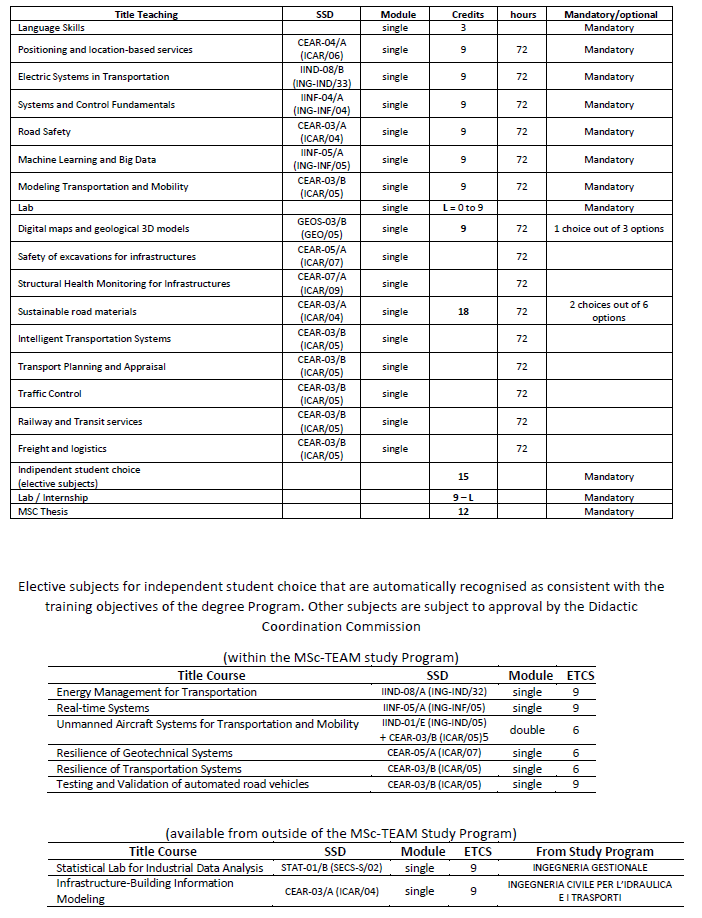
Study Plan
Eligibility and Admission Guidelines
To enroll in the Master’s Degree in Transportation Engineering and Mobility, applicants must meet the following criteria:
a) Hold a Bachelor’s degree (BSc) or equivalent qualification in Engineering (civil, environmental, industrial, informatics, etc.).
b) Possess adequate knowledge in the following subject areas:
- Mathematics, physics, statistics and probability theory
- Basic principles in engineering (structural, civil, industrial, informatics)
c) Have acquired a minimum number of university credits (ECTS) in the following scientific-disciplinary sectors (SSDs):
- At least 36 ECTS in Math (from MATH-01/A to MATH-06/A or MAT/09), and/or Statistics (STAT-01/B), and/or Chemical Sciences (CHEM-03/A or CHEM-06/A), and/or Physical Sciences (PHYS-04/A or PHYS-06/A)
- At least 39 ECTS in Civil Engineering (from CEAR-01/A to CEAR-07/A), and/or Informatics (from INF-01/A to IINF-05/A), and/or Measures (IMIS-01/B), and/or Energetics Engineering (IIND-07/A-B), and/or in the Engineering sectors IIND-02/A or IIND-04/A, and/or in Electric Engineering (IIET-01/A , IIND-08/A, IIND-08/B), and/or Management Engineering (IEGE-01/A)
In the case of a bachelor’s degree outside Italy, the Admission Committee will explicitly evaluate the correspondence between the required SSDs in curricular careers and the disciplinary field of the curricular activities already sustained.
Detailed admission guidelines, particularly relevant for non-EU candidate students, can be found at the MSc website (https://transpeng.unina.it/admission)
Language Requirement:
Applicants must demonstrate proficiency in English equivalent to B2 level (Common European Framework of Reference for Languages).
For full details, please visit the MSc website or write an email:
Website: https://transpeng.unina.it
Email: infotranspeng@unina.it