


The Master of Science (MS) in Autonomous Vehicle Engineering (MOVE) aims to train engineers with intercultural skills, who master themes such as:
- Design and management of autonomous land, air, and sea transport systems.
- Fusion of information to make decisions in real time.
- Sensors and algorithms for driving, navigation, and control with high autonomy level.
- Integration of the autonomous vehicle in complex environments.
Teaching is provided in English and a B2 certification is required for enrolment.
The MS MOVE is a highly interdisciplinary study course aimed to prepare engineers able to operate in the autonomous vehicle world mastering information technology subjects, such as: control, machine learning, big data, data analytics, computer vision, internet of things, integrated transport, smart road as well as their applications to vehicles. To this end an adequate knowledge of vehicles design and operation is also needed. The profile of the engineer will therefore be that of an integrator of systems and technologies, able to operate in two fields of engineering: one more mechanical, namely transportation system dynamics and control, and the other more information technology oriented, in the sense of hardware and software requirement definition and integration for autonomous guidance and navigation.
The MS MOVE includes three more characterized study plans:
- Self-driving cars.
- Autonomous aerial systems.
- Autonomous marine vehicles.
The students will operate in industry-like groups, by interacting with different steps of autonomous vehicle designing and enhancing team working and soft-skills, too.
Study Plan
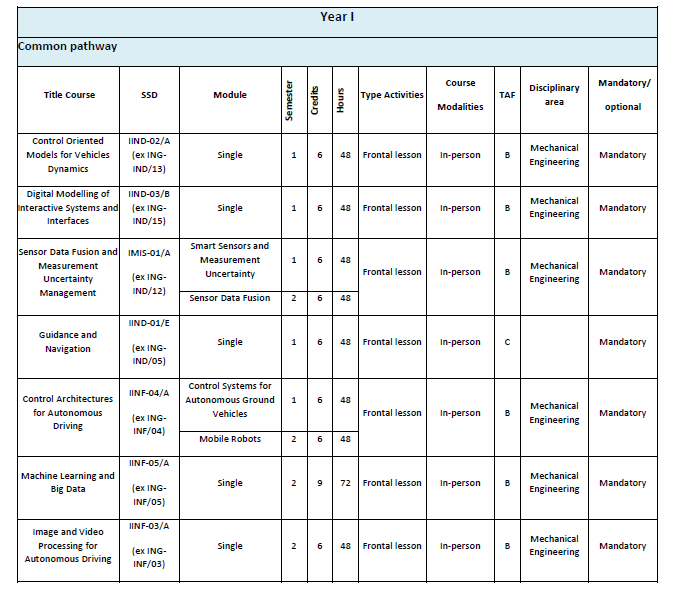
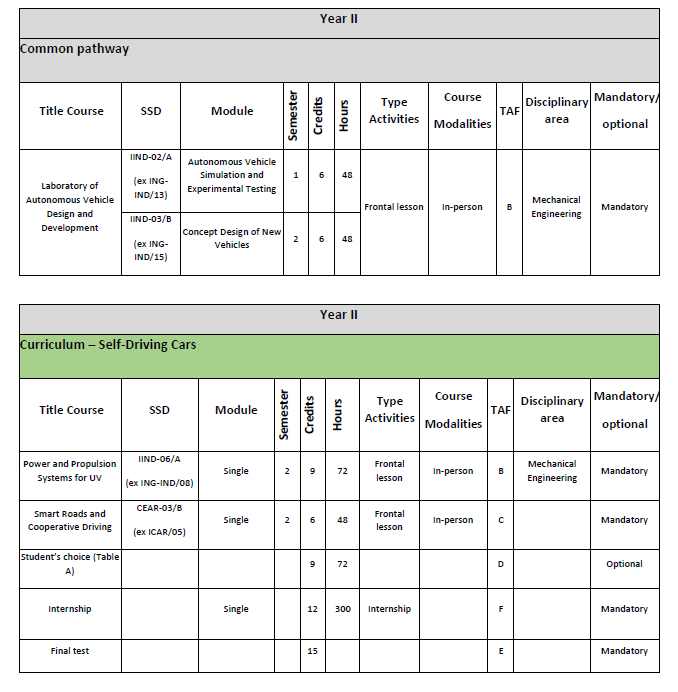
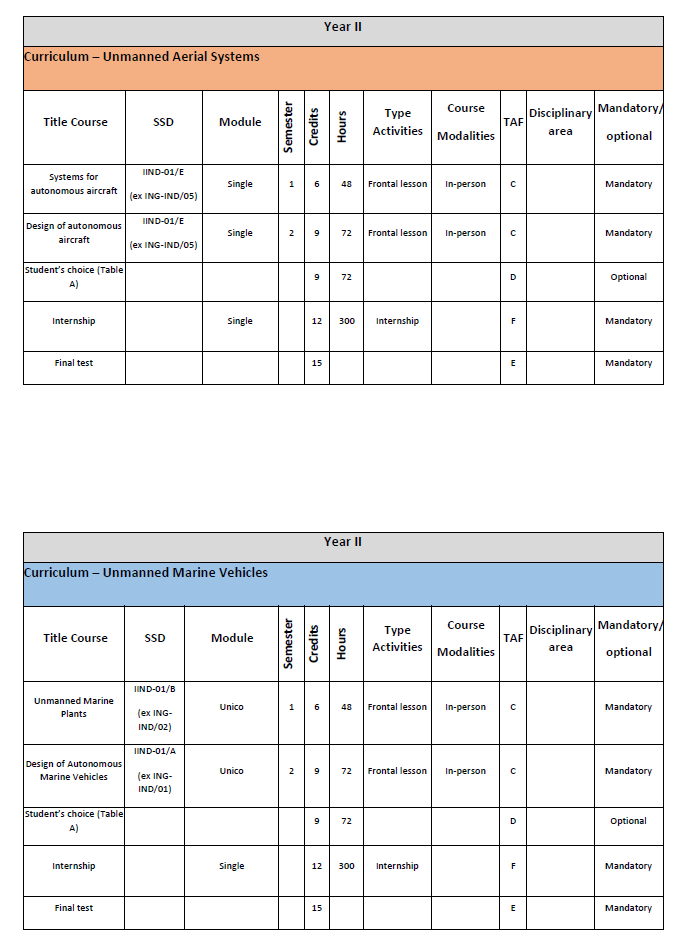
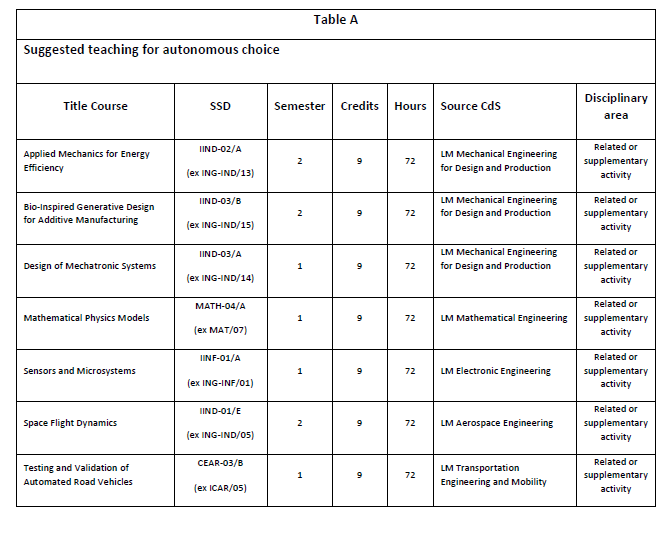
Eligibility and Admission Guidelines
For enrolment in the MS MOVE the possession of one of the following two qualifications is required:
- Three-years degree in Industrial Engineering (Italian L-9 class) or Information Engineering (Italian L-8 class). It must be guaranteed in the bachelor course the passing of a minimum of 12 ECTS in SSD ING-IND/08 – Fluid Machines, ING-IND/09 – Energy and Environment Systems, ING-IND/10 – Applied Physics, ING-IND/12 – Mechanical and Thermal Measurements, ING- IND/13 – Mechanical Engineering Applied to Machinery, ING-IND/14 – Mechanical Design and Machine Construction, ING-IND/15 – Design and Methods for Industrial Engineering, ING-IND/16 – Technologies and Manufacturing Systems, ING- IND/17 – Industrial Mechanical Plants.
- Three-years degree in other scientific or technological degree classes in Italy (L-7 Civil and Environmental Engineering, L-30 Physical Sciences and Technologies, L-31 Information Sciences and Technologies, L-35 Mathematical Sciences) or qualification obtained abroad (for example BS or BEng) in the scientific or technological field if it is recognized suitable by the Teaching Committee. The passing of a minimum number of 36 ECTS in the following scientific disciplines must be guaranteed: INF/01 – Computer Science, ING-INF/05 – Information Processing Systems, MAT/03 – Geometry, MAT/05 – Calculus, FIS/01 – Experimental Physics. Furthermore, it must be guaranteed, in the Bachelor course, the passing of a minimum of 12 ECTS in SSD ING-IND/08 – Fluid Machines, ING-IND/09 – Energy and Environment Systems, ING-IND/10 – Applied Physics, ING-IND/12 – Mechanical and Thermal Measurements, ING- IND/13 – Mechanical engineering applied to machinery, ING-IND/14 – Mechanical design and machine construction, ING-IND/15 – Design and methods of industrial engineering, ING-IND/16 – Technologies and manufacturing systems, ING- IND/17 – Industrial mechanical plants.
Furthermore, knowledge of English is required for access, at least at a level comparable to B2 of the European Framework of Reference for Languages with certification issued by the University or by an accredited body.
The Teaching Committee also disciplines the methods for verifying the adequacy of the student’s personal preparation. With reference to the qualifications referred to the above case 1, students fulfil personal preparation requirement when the average grade is not less than 24/30.
For full details, please visit the MOVE website or write an email:
Website: move.dii.unina.it
Email: move@unina.it