


Goals
The Degree in Civil and Environmental Engineering aims at training graduates with the scientific, technical, and cultural requisites useful to understand, solve and manage the basic problems related to the design, construction, conduction, control, maintenance and safety keeping of civil works and of the built environment in which they are inserted, with particular reference to the demand and standards of the international professional and construction market.
Knowledge
In order to pursue the educational objectives of the Degree Program, the basic disciplines are selected and sized to provide the necessary cognitive elements to know and understand the methodological-operational aspects of mathematical analysis, experimental physics, analytical geometry and theoretical mechanics. These disciplines are placed in the first year of studies and in the first semester of the second year.
Teaching
Characterising educational activities deal with the methodological-operational aspects of the basic sciences of civil engineering: structural mechanics and engineering, hydraulics and hydraulic infrastructures, soil mechanics and geotechnical engineering, transport infrastructures and transportation engineering, sanitary and environmental engineering. These disciplines are placed in the second year, where notions of fluid and solid mechanics are mainly taught as preparatory to applications, and in the third year, where training turns into a more applied approach, studying the construction materials with their physical-mechanical behaviour and the engineering applications.
The related and supplementary activities aim at enriching and completing the interdisciplinary preparation of the graduate, providing specialized content and methodology.
The free-choice credits allow the student to deepen his or her cultural interests and better target the job market or a second-level degree.
Techniques
The studies encompass innovative methods, techniques and calculation tools, experiments and simulations of applicative problems and they are aimed at stimulating in the graduate a critical mind and awareness of contemporary contexts, at the development of relational and decision-making skills and at encouraging continuous education.
Study Plan
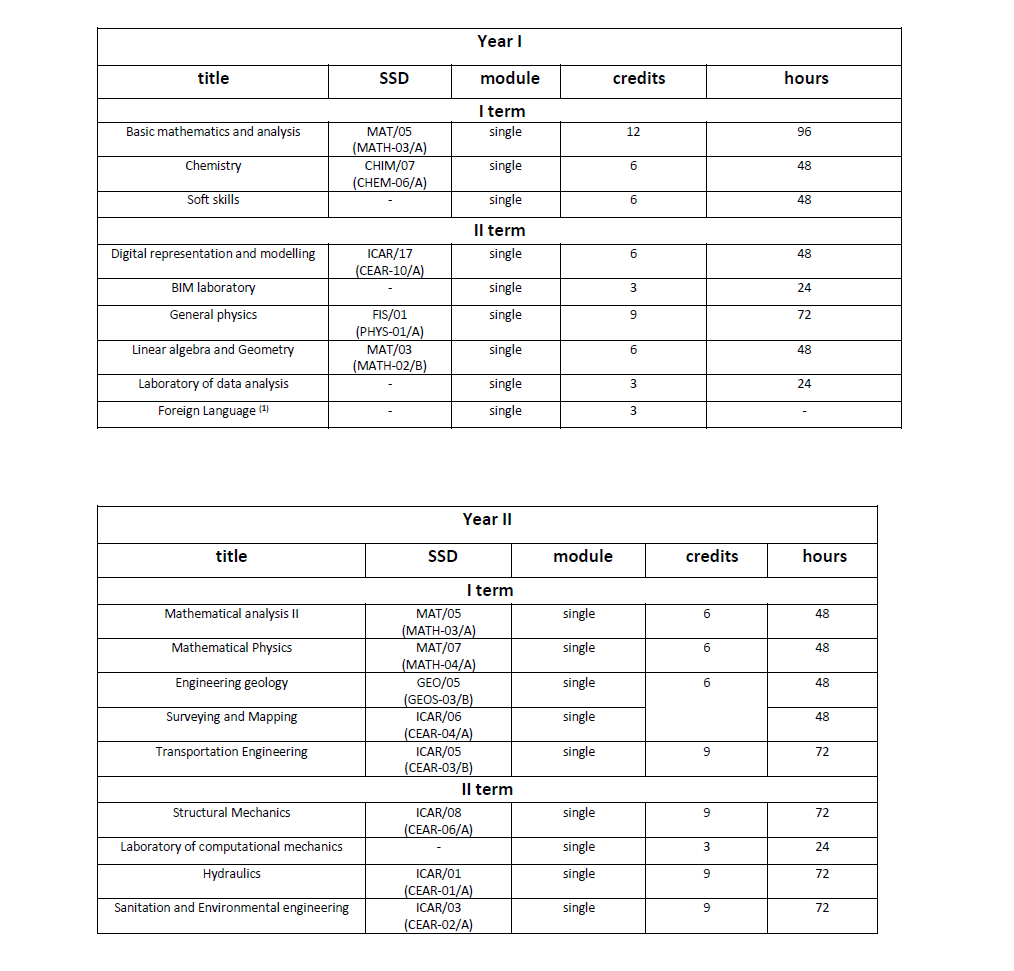
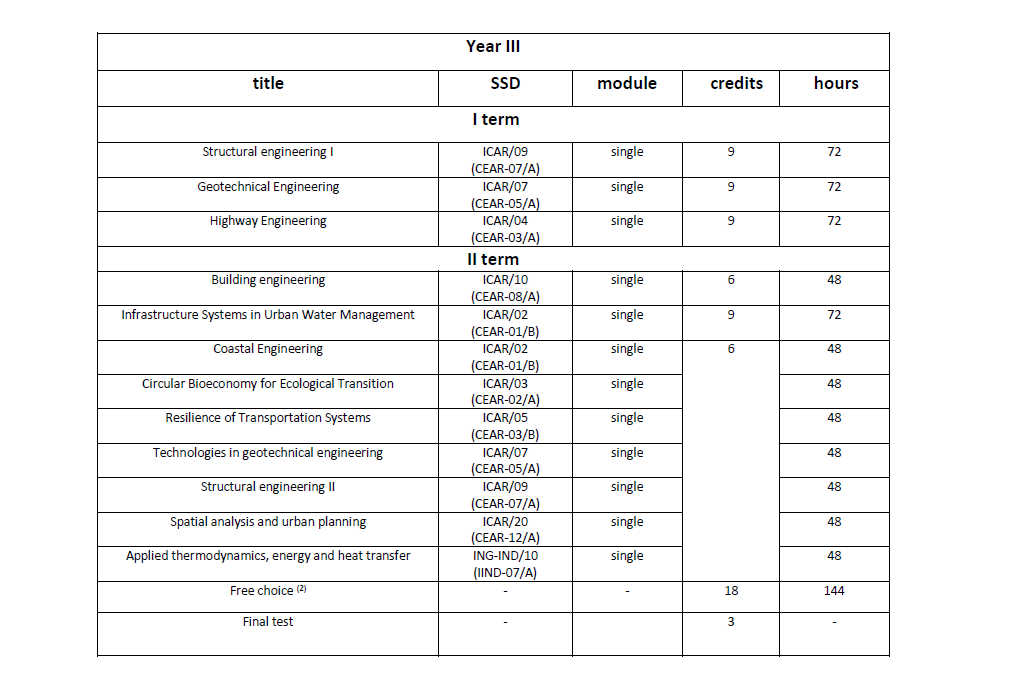
Eligibility and Admission Guidelines
The Course is taught in English and it is open to Italian and international students. Non-EU students who require a visa must follow a pre-admission phase, culminating in receiving a pre-admission letter (https://www.civil-environmental.unina.it/admission/).
Both non-EU and EU candidate students need educational requisites. The following are required as student’s personal preparation: a) logical ability and b) basic scientific knowledge.
a) Ability to correctly interpret the meaning of a text. Ability to identify the input data of a problem and to use them solve it; ability to deduce the behaviour of a simple system; ability to link results to the hypotheses that determine them.
b) Properties and operations on numbers; absolute value; powers and roots; logarithms and exponentials; literal calculus; polynomials; first and second degree algebraic equations and inequalities; systems of first degree equations; measure and properties of segments and angles; lines and planes; properties of the main plane and solid geometric figures; Cartesian coordinates; concept of function; equations of lines and simple geometric loci; graphs and properties of elementary functions and trigonometric functions. Elementary physics and basic knowledge of the structure of matter.
Personal preparation is ascertained by means of a compulsory selective test.
The compulsory selective test, required for admission to the Degree Program, is administered by the CISIA Consortium (English TOLC-I). It is conducted remotely(TOLC@CASA) after registering on the CISIA website. The compulsory selective test is repeatable to allow students to measure their skills and abilities against the requirements of the degree course and improve them through individual study.
For the purposes of enrolment, the candidate must reach the minimum threshold of 20% of the maximum score for the test.
Admitted candidates who did not score more than 50% of the marks available for the Mathematics section of the test (i.e. 10) and at least 15 marks overall (i.e over the 50 available points) will be assigned an Additional Formative Obligation (OFA) that requires them to acquire at least 9 University Credits (CFU) in the MAT/05 subject area before being able to sit any other examinations. In any case, the educational debt must be cleared within the first year of the course.
Both non-EU and EU candidate students must provide certified evidence of English language proficiency at B2 or higher (CEFR level).